Saturday, November 22, 2014

CITIZEN FOUR, a documentary film by Laura Poitras


It is chilling to know for a fact that since 9/11/2001, the U.S’s National Security Agency, NSA, has been and is tracking phone calls from ATT and Verizon, also bank activity, internet searches, and all social media sites used by every person in America.  It also tracks our credit card purchases- on the internet or from brick and mortar stores.  The information was revealed by Edward Snowden to filmmaker, documentarian Laura Poitras and journalist Glenn Greenwald at a clandestine meeting in a Hong Kong hotel room over a period of eight days in May 2013.  How Greenwald was going to write it up is a huge part of Laura Poitras’s important, shocking, documentary film, “Citizen Four.” 
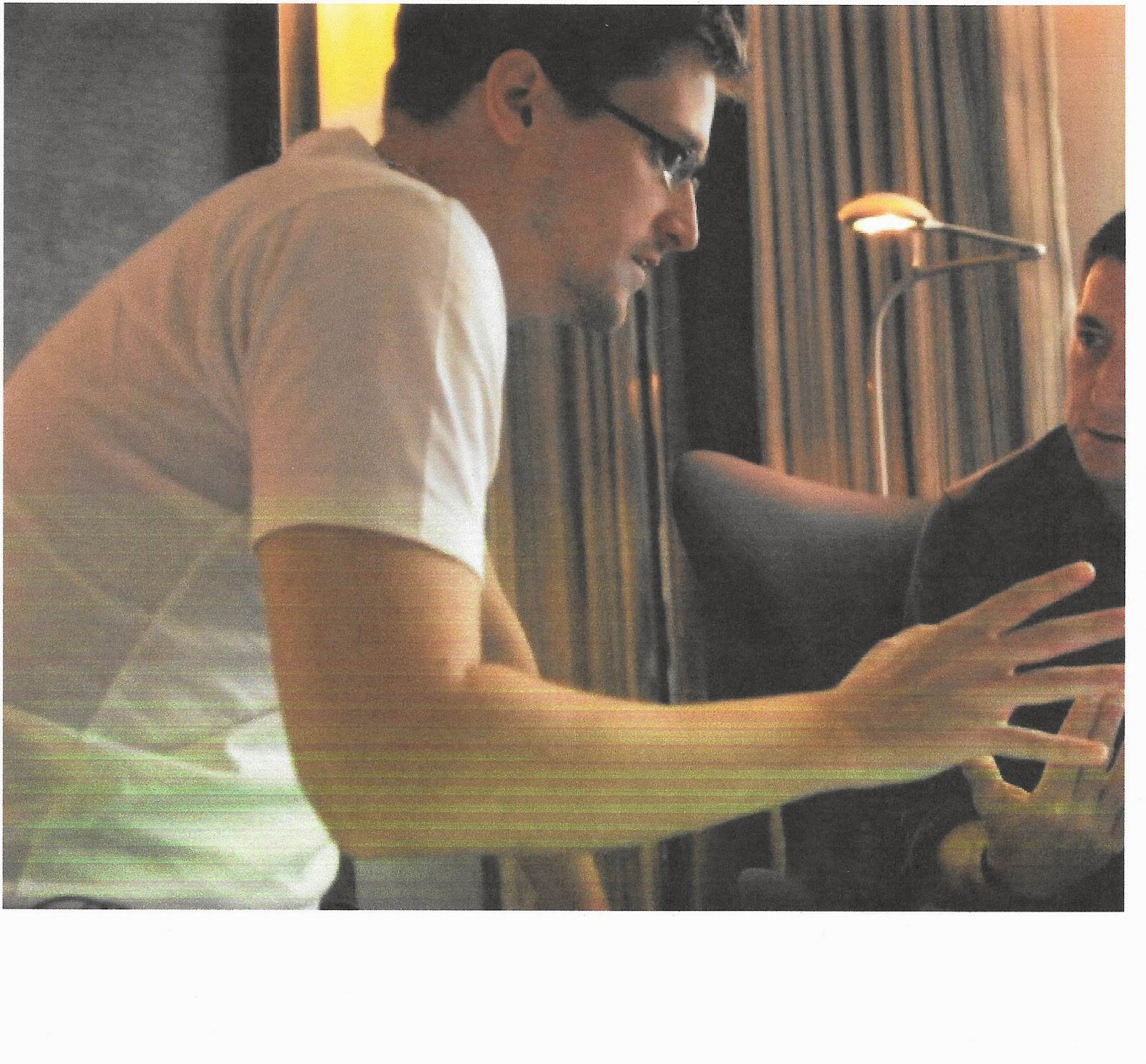
 
Edward Snowden (left) and Glenn Greenwald in Hong Kong
Snowden was a contract employee for the consulting firm Booze Allen Hamilton in their Hawaii offices.  They lent his services to the NSA as a systems administrator/consultant.  Snowden is a young, slim, dark haired, 29 year-old, who had at first seen the importance of looking for data disclosing terrorist plots from militant groups like al Queda.  Instead, while advising superiors at the NSA on methods of developing security systems against hackers, he discovered files on  its domestic spying activities against US citizens.

Subsequently, Snowden downloaded into his computer (he had the highest security clearance because of his expertise and had unlimited access) many thousands of implicating files. Then, knowing of Poitras’s revelatory, documentary films, specifically one about the whistleblower, William Binney, he began emailing her using the code name Citizen Four, hinting at what he had in his possession.  Snowden also came to know Poitras from the Guardian’s Glenn Greenwald’s article about her mentioning to him that she was a “government target.”  Snowden had previously tried to interest Greenwald but Greenwald never followed through as he felt Snowden’s method of encrypting email too annoying.  He changed his mind when Snowden connected with Poitras. 

Writer Barton Gellman, then a journalist at the Washington Post, became involved in May 2013, when the Post declined to “guarantee publication within 72 hours of all the Power Point slides that Snowden had leaked exposing the PRISM electronic data mining program (which searched Google, Yahoo, etc.) and would eventually lead to a code allowing Snowden to later prove that he was the source.  In the film he tells Poitras, he knew the wiretapping was wrong, unconstitutional- an infringement on the privacy of anyone living in the US.  He wanted it to be known, publicly, but how would be tricky.  He has said that he abides by the US Constitution’s 4th and 5th Amendments.  “I have no intention of hiding who I am because I know I have done nothing wrong.”

Poitras’s film opens with a black screen with Snowden’s keystrokes appearing as though he’s typing his queries to her in real time.  Her answers appear below his messages in the same way.  After confirming his identity, and involving investigative journalist, Glen Greenwald of UK’s The Guardian.  The three agree to meet at a secure location in a Hong Kong hotel, in May 2103.  The film was shot almost entirely in Snowden’s small, no-frills room where everything is white: the bedding, walls, carpets, and window covering.  So it was a color shock when Snowden covered his head and laptop with a red cowl (he works propped up on his bed) so the camera couldn’t capture his keystrokes.  Scenes of the Hong Kong skyline and other outdoor sites give the audience a break from the room’s claustrophobic atmosphere.  At one point, the fire alarm goes off.  Paranoid, the three suspect that they’re being monitored.  The alarm sounds off-and-on three or four times.  They conclude that it’s a test and call the front desk and it is confirmed.  Only then did they relax. 
Snowden explains and demonstrate on his laptop how he accessed the information.  Much of which was conveyed using tech-talk.  To one unfamiliar with the jargon, it is extremely difficult to follow let alone understand.  At one point, Snowden insists that Poitras’s film not be about him, but what his files reveal about the NSA secret international and domestic spying activities in cahoots with the UK.  For example his files reveal that the NSA has been spying on Germany’s Angela Merkel since 2002.
   
Poitras includes in her film footage of the courtroom scene in the 9th Circuit Court in San Francisco when ATT was sued for spying on its customers phone calls (discovered by an ATT employee.)  The people won the suit.  She also includes footage of former Director of National Intelligence, James Clapper’s testimony before the Senate Select Committee on Intelligence where he denies that NSA collects data on millions or hundreds of millions of Americans.  When pressed, Clapper added: “Not wittingly, there are cases where they could inadvertently, perhaps, collect, but not wittingly.”  Poitras shows a clip of Wikileaks founder and whistleblower Julian Assange trying and failing to get asylum for Snowden in various countries after threats surfaced from the U.S government to Snowden’s life and liberty should he return voluntarily.  However the U.S. revoked his passport.
Edward Snowden ended up in Moscow after spending close to three months in limbo in the Moscow airport, first granted a one-year stay which was then renewed for three.  There, in January 2014, during an interview he was asked why he decided to blow the whistle, he replied: “Sort of the breaking point was seeing Clapper, directly lie under oath to Congress . . . that really meant for me there was no going back.”
By his own words, backed up by extensive research, Snowden has not released his appropriated files by transfer of USB flash drives to any foreign governments.  He wanted only that the public be made aware of the matter through the media, reportage, and publication of the files.  As one critic noted, if Snowden is as willing to accept the consequences of his actions, i.e. jail time, why is he hiding out in Moscow?  When you have members of the US Congress labeling him a traitor and Senator Diane Feinstein all but calling for his head, does he or anyone believe he will get a fair trial?  And notable government figures as disparate as Ron Paul and Bernie Sanders, plus the editorial boards of the Washington Post and the Guardian, wonder why is NSA not on trial for illegal wiretapping which Snowden has proven in spades?  
When the film ended, we in the audience erupted with applause.  Someone shouted, “We are all on the list.” Another said, “Okay, so now what do we do?”   As the credits rolled and the lights came up, a voice was heard to say, “Revolution!”  If we weren’t on the list before, we certainly are now.

Note:  This review has been published in the November 2014 editions of Socialist Action News:  Go to www.socialistaction.org to check out other articles and editorial content.

Monday, August 25, 2014

LUCY- Not Only in the Sky, but Everywhere

Morgan Freeman and Scarlett Johansson in "LUCY"


"Lucy"directed by Luc Besson, starring Scarlett Johansson and Morgan Freeman.

A MINI REVIEW

I'll come right out and say it.  I thought this film was stupid- but fun, in a way. Still, beneath the talents of the director and stars.

Trampy Lucy (Scarlett Johansson) in a denim jacket and miniskirt, becomes an unwilling drug mule carrying an illegal drug that looked to me to be a bag of blue crystal meth straight out of Breaking Bad's Walter White's lab.  The drug is sewn into her abdomen by compromised surgeons beholden to an Asian drug lord, and into other unwitting, duped, drugged foreigners.  A side effect of the drug is that it increases your brain capacity to 100%.  Seems the eminent neuro-biologist, Professor Norman (Morgan Freeman) is researching drugs that could do just that!  When her “package” starts leaking, and her brain starts revving up, the new Lucy is transformed into a sophisticated, worldly woman, wearing a skinny black dress and a better hairdo.  Lucy’s newly acquired brain-power allows her to wield heavy weapons and AK 47s  which she employs to blow away an army of well-dressed, identical-looking Asian mobsters involved in the drug deal while enjoying some heavy trippin'.  (Some special effects looked like 1970s light-shows, or scenes from Terrence Malick's  "Tree of Life.") In Professor Norman’s lab, she then mysteriously evolves into a gooey, crawling black kudzu that invades and appears to destroy all the computers, the furniture, the walls- everything but humans and her little black chair; she ends up a thumb-drive.  Yeah.  But Lucy, as thumb-drive now in the professors capable hands, contains all the information needed to increase the brain capacity of all human beings.  Yikes!

Saturday, August 9, 2014

A Most Wanted Man


To Make the World a Safer Place
Willem Dafoe (l) and Seymour Phillip Hoffman 

By GAETANA CALDWELL-SMITH

A Most Wanted Man, directed by Anton Corbijn, based on the novel by John le Carré.

Director Corbijn set “A Most Wanted Man” in the port city of Hamburg, site of Mohammad Atta’s planning for the al-Queda jet-plane attacks on the World Trade Center and the Pentagon. Only now, it’s a decade later. Since 2001, American and European governments have stepped up the clandestine anti-terrorist divisions of their secret service organizations. Things have heightened so much since 9/11 that no governments dare tell the truth anymore.
Corbijn’s film, although a fictional account, realistically depicts elements of what we are learning from the Edward Snowden leaks about U.S. government spying. The film shows that in relations between U.S. and European spy agencies, the U.S. is really in control.
A puffy, overweight Hoffman, in one of his best roles, his last- before his tragic death from a drug overdose a year ago, plays Günther Bachman, a weary, soft-spoken German intelligence operative. He gets word that a possible terrorist suspect has arrived in the city. This sets the wheels in motion: Who is this guy; who are his connections in Hamburg; where did he come from and how?
The guy, Issa Karpov (Grigoriy Dobrygin) is a Chechen Muslim—a victim of torture. Karpov is thin, wiry, haunted, with a long, scraggly beard—the stereotypical look of a Muslim terrorist. He wears a knitted cap over his unkempt hair, a hoodie, and jeans. His posture is that of a hunted man. Unfortunately, he simply looks “guilty”—even though he has not done anything but enter the country illegally to claim his dead father’s money. His “handlers” in his home country have arranged for him to stay with a young Muslim family.
Rachel McAdams plays Annabel Richter, a human rights attorney, who wants to help him. But the German equivalent of the U.S. Homeland Security—Bachman’s superiors—are on to him, which puts into jeopardy the lives of the people with whom he stayed. Part of the plot is for Richter to hide him until she can arrange a hearing with an official to hear his case. She brings him food, toiletries, blankets, etc. She obviously has fallen for him.
It turns out that Issa Karpov’s dead father left a ton of money in a bank deposit box. Issa decides to turn the money over to Dr. Abdullah (Homayoun Ershadi), a noted Islamic academic who donates to several Middle East charities and organizations. The government spy agencies suspect that one might be a front for al-Queda, but there is no evidence to prove it. A wonderfully cast Willem Dafoe plays Tommy Brue, the bank official who oversees large deposits and keeps records of secret account numbers. He must approve Richter and Bachman’s access to the safe deposit box.
Things heat up when Martha Sullivan (Robin Wright, as silkily evil as she was on Netflix’s “House of Cards”), a U.S. Homeland Security official, gets Bachman to let down his guard against the Americans, and to work with them in the hunt for Karpov.
After nail-biting suspense (in fact, throughout the film), we breathe a sigh of relief when all appears to go smoothly: Papers are finalized and asylum is granted for Karpov. Tragically, without Bachman and Richter’s knowledge, Sullivan and her smarmy, sneaky U.S. and German cohorts—oily, older, grey-haired, expensively dressed men—have set up their own sting.
The ending is shockingly brutal and heartbreaking, as Martha Sullivan looks on in smug satisfaction. Bachman’s rage is palpable as, alone in the parking lot, he rails at their blatant betrayal: “To make the world a safer place.”

This review also appears in the August issue of Socialist Action News  www.socialistaction.org


Saturday, July 5, 2014

SNOWPIERCER, a new film by South Korean filmmaker Joon Ho Bong.


SNOWPIERCER, directed by Joon Ho Bong, starring Chris Evans, Jamie Bell, Octavia Spencer , Ed Harris, Tilda Swinton, and John Hurt.
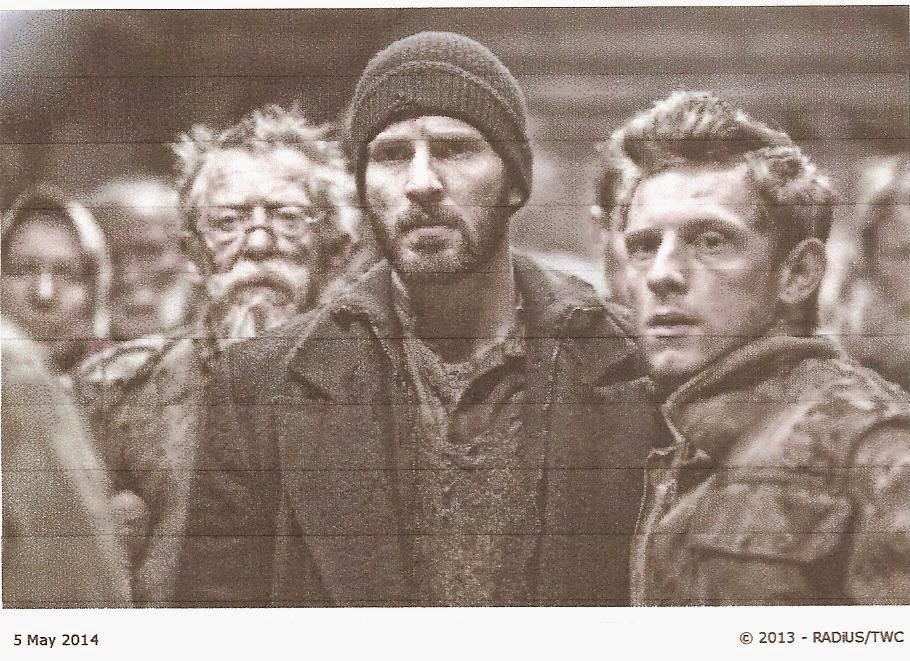
John Hurt as Gilliam, Chris Evans as Curtis and Jamie Bell as Edgar in SNOWPIERCER
 
SNOWPIERCER, directed by South Korean filmmaker Joon Ho Bong (The Host,  Mother), in his first English language film,  is truly an original, inventive, futuristic work which transcends all previous apocalyptic films.  He gives us a devastating concept of what may happen not too far in the future.   It appears that world government leaders, corporate heads, and the clueless 1%  had refused  to act to stop toxic emissions and a “quick fix”  radically affected the climate, causing the entire Earth, its oceans, and all waterways  to freeze.  Every living thing has died except for a hundred or so humans who were passengers on a high-speed, perpetual motion train. 

The film opens to reveal that the train has been endlessly circling the frozen globe for seventeen years.   Third class passengers-  families, including children born on the train who know no other life- have been relegated to the  last few  cars.   They live in squalor, like concentration camp prisoners, and ravenously gobble mass produced, slimy black “protein bars;" their clothes now shapeless, colorless rags.  They are kept in check by fascist-like, heavily armed guards lest they try to make their way to first class.  The head of the guards is Mason –Tilda Swinton- at her merciless best.  She is saved by being an unintentional comic figure.  She lectures the lower classes on “the eternal order” in which the privileged hold sway over “ungrateful scum.”  She looks like someone’s worst idea of a Dean of Girl’s in an all-girl boarding school, with her owlish glasses, unbecoming false teeth, and straight brown hair clipped back with bobby pins.  She barks out orders in a saliva-laced, strident voice,  wearing the white, militaristic outfit of an overweight high-school marching band tuba player. 

Chris Evans, Tilda Swinton, and Octavia Spencer


Trouble begins when Mason and one of her plus-size female flunkies visits the third class cars, wearing a scarf over their face to ward off the smell.  They’ve come to measure and recruit a young child, Tanya’s boy (the reason is revealed later).  Tanya is played by Octavia Spencer in another strong, no-holds-barred role.  John Hurt plays Gilliam, the wise-old sage to whom they seek for advice.  Hurt’s buddy is Curtis, a young, healthy, handsome man of the Clive Owen type, played by Chris Evans of superhero fame (Captain America, etc).  As Robin is to Batman, so Jamie Bell’s Edgar is to Curtis.  Gilliam is trusted to intervene for them with Wilford (Ed Harris, in a role not unlike the God-like figure he played in The Truman Show).   Those in first class live, eat, play, and sleep under his  protection .  This is Wilford’s train.  Enamored by railways as a toddler, he went on to build and own them, and construct an empire of trains, eventually inventing the perpetual motion engine that keeps his Snowpiercer running.

The landscape scenes are stunning- a relief to the claustrophobic interiors.  We watch as the ice encrusted train  weaves its way through mountains, over icicle-draped bridges spanning frozen rivers and lakes, past awesome frozen cities, their landmark buildings barely discernible beneath icy carapaces.  The passengers’ windows are iced shut so they are denied the gorgeous vision of what is just inches away.  When someone complains, the punishment is a frozen body part which guards sledgehammer into pieces while the victim is left to writhe in agony.  When such an incident occurred on top of the kidnapping of Tanya’s boy, they’ve had enough.  They must get to the front of the train.  Gilliam selects an unwitting Curtis as leader. 
   
They make their way from car to car, fighting the guards with axes and makeshift weapons and gain the upper hand when Curtis realizes that there are no bullets in their guns because bullets were outlawed decades ago (would that this were so today).  To access Wilford’s quarters, Curtis must get the secret code from the Inuit, Namgoong Minsoo (Korean actor Kang Ho Song) , who is traveling with his  daughter, Yona (Ah sung Ko).  He is stoned on something called Kona, which is compounded from chemical waste (The fact that he and Yona are Inuit and the makeup of the drug are vital elements to the film’s ultimate resolution) .  He will give Curtis the code as long as he is supplied with the drug. 
   
Curtis and Edgar’s task is to key in a  code to each door that separates the cars.  Once open, they have a few seconds before they close.  The  ensuing battles  are gory, violent and bloody.  The guards closest to the front of the trains do have bullets.  One pierces a window; a wounded Namgoong  lies there watching  a tiny snowflake drift in through the hole; his eyes light up and you wonder what he is thinking.   Curtis, Yona and the others pass from one car to the next through startling scenes of sunlight streaming through glass domes on lush gardens, greenhouses with fruit-bearing trees, vegetable patches, and domestic  animals; one car is a night-club with a rave going on as trendy first classers drink and dance to techno–rock.  There’s a sedate club car where patrons sit quietly drinking and reading.  They react in revulsion and horror  as the masses and guards hack and shoot their way through.

The film is full of surprises:  There’s a scene in a typical grade school class in one of the forward cars.  The pregnant teacher leads her students in a song about what happens when the engine breaks down.  They repeat the chorus in unison, singing: “We all freeze and die,” with appropriate arm-waving.  She then pulls a gun and starts shooting at Curtis and his followers.  Wilford’s hefty female employees look as though they haven’t progressed from the 1950s’ clean, scrubbed look and style.  

A bank vault-like door finally opens onto Wilford’s luxury car as he, dressed in a long silk robe, is sautéing a steak while Curtis looks on, hungrily.  Wilford babbles on with his evil, airy philosophy about his oligarchic goals and dreams, and reveals a startling clue about his relationship to Gilliam.  As David Denby stated in the July 7 & 14 issue of The New Yorker, comparing films like “Elysium” and “Hunger Games,” he says, “Snowpiercer  presents a portrait of oligarchical rule and underclass  discontent.  Fueled by disgust of the decadent rich and admiration of the outraged poor.”  He then asks, “Is revolution being hatched in commercial cinema?”

A version of this review can also be found in Socialst Action News.  Go to www.socialistaction.org