Saturday, August 9, 2014

A Most Wanted Man


To Make the World a Safer Place
Willem Dafoe (l) and Seymour Phillip Hoffman 

By GAETANA CALDWELL-SMITH

A Most Wanted Man, directed by Anton Corbijn, based on the novel by John le Carré.

Director Corbijn set “A Most Wanted Man” in the port city of Hamburg, site of Mohammad Atta’s planning for the al-Queda jet-plane attacks on the World Trade Center and the Pentagon. Only now, it’s a decade later. Since 2001, American and European governments have stepped up the clandestine anti-terrorist divisions of their secret service organizations. Things have heightened so much since 9/11 that no governments dare tell the truth anymore.
Corbijn’s film, although a fictional account, realistically depicts elements of what we are learning from the Edward Snowden leaks about U.S. government spying. The film shows that in relations between U.S. and European spy agencies, the U.S. is really in control.
A puffy, overweight Hoffman, in one of his best roles, his last- before his tragic death from a drug overdose a year ago, plays Günther Bachman, a weary, soft-spoken German intelligence operative. He gets word that a possible terrorist suspect has arrived in the city. This sets the wheels in motion: Who is this guy; who are his connections in Hamburg; where did he come from and how?
The guy, Issa Karpov (Grigoriy Dobrygin) is a Chechen Muslim—a victim of torture. Karpov is thin, wiry, haunted, with a long, scraggly beard—the stereotypical look of a Muslim terrorist. He wears a knitted cap over his unkempt hair, a hoodie, and jeans. His posture is that of a hunted man. Unfortunately, he simply looks “guilty”—even though he has not done anything but enter the country illegally to claim his dead father’s money. His “handlers” in his home country have arranged for him to stay with a young Muslim family.
Rachel McAdams plays Annabel Richter, a human rights attorney, who wants to help him. But the German equivalent of the U.S. Homeland Security—Bachman’s superiors—are on to him, which puts into jeopardy the lives of the people with whom he stayed. Part of the plot is for Richter to hide him until she can arrange a hearing with an official to hear his case. She brings him food, toiletries, blankets, etc. She obviously has fallen for him.
It turns out that Issa Karpov’s dead father left a ton of money in a bank deposit box. Issa decides to turn the money over to Dr. Abdullah (Homayoun Ershadi), a noted Islamic academic who donates to several Middle East charities and organizations. The government spy agencies suspect that one might be a front for al-Queda, but there is no evidence to prove it. A wonderfully cast Willem Dafoe plays Tommy Brue, the bank official who oversees large deposits and keeps records of secret account numbers. He must approve Richter and Bachman’s access to the safe deposit box.
Things heat up when Martha Sullivan (Robin Wright, as silkily evil as she was on Netflix’s “House of Cards”), a U.S. Homeland Security official, gets Bachman to let down his guard against the Americans, and to work with them in the hunt for Karpov.
After nail-biting suspense (in fact, throughout the film), we breathe a sigh of relief when all appears to go smoothly: Papers are finalized and asylum is granted for Karpov. Tragically, without Bachman and Richter’s knowledge, Sullivan and her smarmy, sneaky U.S. and German cohorts—oily, older, grey-haired, expensively dressed men—have set up their own sting.
The ending is shockingly brutal and heartbreaking, as Martha Sullivan looks on in smug satisfaction. Bachman’s rage is palpable as, alone in the parking lot, he rails at their blatant betrayal: “To make the world a safer place.”

This review also appears in the August issue of Socialist Action News  www.socialistaction.org


Saturday, July 5, 2014

SNOWPIERCER, a new film by South Korean filmmaker Joon Ho Bong.


SNOWPIERCER, directed by Joon Ho Bong, starring Chris Evans, Jamie Bell, Octavia Spencer , Ed Harris, Tilda Swinton, and John Hurt.
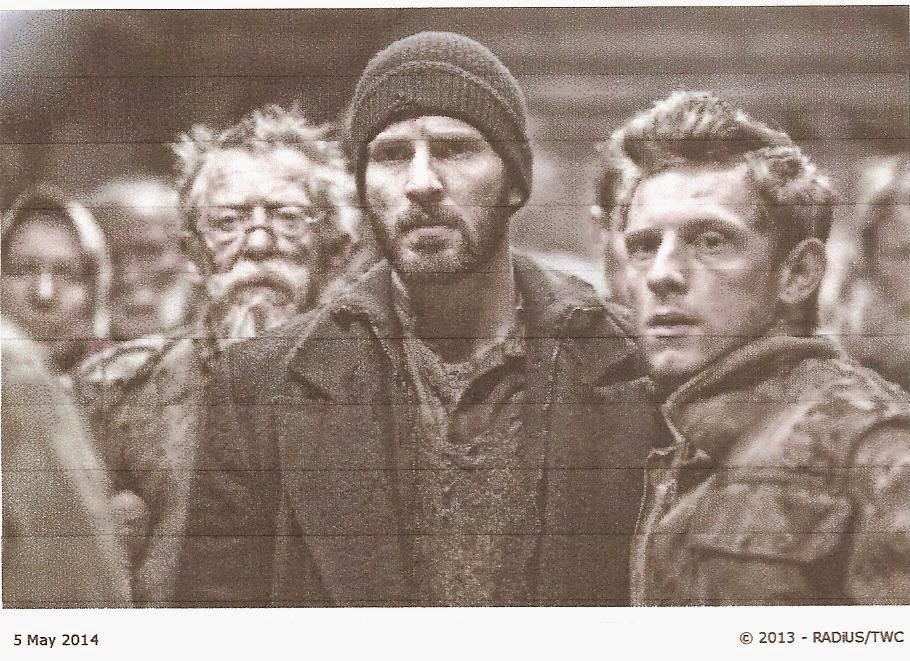
John Hurt as Gilliam, Chris Evans as Curtis and Jamie Bell as Edgar in SNOWPIERCER
 
SNOWPIERCER, directed by South Korean filmmaker Joon Ho Bong (The Host,  Mother), in his first English language film,  is truly an original, inventive, futuristic work which transcends all previous apocalyptic films.  He gives us a devastating concept of what may happen not too far in the future.   It appears that world government leaders, corporate heads, and the clueless 1%  had refused  to act to stop toxic emissions and a “quick fix”  radically affected the climate, causing the entire Earth, its oceans, and all waterways  to freeze.  Every living thing has died except for a hundred or so humans who were passengers on a high-speed, perpetual motion train. 

The film opens to reveal that the train has been endlessly circling the frozen globe for seventeen years.   Third class passengers-  families, including children born on the train who know no other life- have been relegated to the  last few  cars.   They live in squalor, like concentration camp prisoners, and ravenously gobble mass produced, slimy black “protein bars;" their clothes now shapeless, colorless rags.  They are kept in check by fascist-like, heavily armed guards lest they try to make their way to first class.  The head of the guards is Mason –Tilda Swinton- at her merciless best.  She is saved by being an unintentional comic figure.  She lectures the lower classes on “the eternal order” in which the privileged hold sway over “ungrateful scum.”  She looks like someone’s worst idea of a Dean of Girl’s in an all-girl boarding school, with her owlish glasses, unbecoming false teeth, and straight brown hair clipped back with bobby pins.  She barks out orders in a saliva-laced, strident voice,  wearing the white, militaristic outfit of an overweight high-school marching band tuba player. 

Chris Evans, Tilda Swinton, and Octavia Spencer


Trouble begins when Mason and one of her plus-size female flunkies visits the third class cars, wearing a scarf over their face to ward off the smell.  They’ve come to measure and recruit a young child, Tanya’s boy (the reason is revealed later).  Tanya is played by Octavia Spencer in another strong, no-holds-barred role.  John Hurt plays Gilliam, the wise-old sage to whom they seek for advice.  Hurt’s buddy is Curtis, a young, healthy, handsome man of the Clive Owen type, played by Chris Evans of superhero fame (Captain America, etc).  As Robin is to Batman, so Jamie Bell’s Edgar is to Curtis.  Gilliam is trusted to intervene for them with Wilford (Ed Harris, in a role not unlike the God-like figure he played in The Truman Show).   Those in first class live, eat, play, and sleep under his  protection .  This is Wilford’s train.  Enamored by railways as a toddler, he went on to build and own them, and construct an empire of trains, eventually inventing the perpetual motion engine that keeps his Snowpiercer running.

The landscape scenes are stunning- a relief to the claustrophobic interiors.  We watch as the ice encrusted train  weaves its way through mountains, over icicle-draped bridges spanning frozen rivers and lakes, past awesome frozen cities, their landmark buildings barely discernible beneath icy carapaces.  The passengers’ windows are iced shut so they are denied the gorgeous vision of what is just inches away.  When someone complains, the punishment is a frozen body part which guards sledgehammer into pieces while the victim is left to writhe in agony.  When such an incident occurred on top of the kidnapping of Tanya’s boy, they’ve had enough.  They must get to the front of the train.  Gilliam selects an unwitting Curtis as leader. 
   
They make their way from car to car, fighting the guards with axes and makeshift weapons and gain the upper hand when Curtis realizes that there are no bullets in their guns because bullets were outlawed decades ago (would that this were so today).  To access Wilford’s quarters, Curtis must get the secret code from the Inuit, Namgoong Minsoo (Korean actor Kang Ho Song) , who is traveling with his  daughter, Yona (Ah sung Ko).  He is stoned on something called Kona, which is compounded from chemical waste (The fact that he and Yona are Inuit and the makeup of the drug are vital elements to the film’s ultimate resolution) .  He will give Curtis the code as long as he is supplied with the drug. 
   
Curtis and Edgar’s task is to key in a  code to each door that separates the cars.  Once open, they have a few seconds before they close.  The  ensuing battles  are gory, violent and bloody.  The guards closest to the front of the trains do have bullets.  One pierces a window; a wounded Namgoong  lies there watching  a tiny snowflake drift in through the hole; his eyes light up and you wonder what he is thinking.   Curtis, Yona and the others pass from one car to the next through startling scenes of sunlight streaming through glass domes on lush gardens, greenhouses with fruit-bearing trees, vegetable patches, and domestic  animals; one car is a night-club with a rave going on as trendy first classers drink and dance to techno–rock.  There’s a sedate club car where patrons sit quietly drinking and reading.  They react in revulsion and horror  as the masses and guards hack and shoot their way through.

The film is full of surprises:  There’s a scene in a typical grade school class in one of the forward cars.  The pregnant teacher leads her students in a song about what happens when the engine breaks down.  They repeat the chorus in unison, singing: “We all freeze and die,” with appropriate arm-waving.  She then pulls a gun and starts shooting at Curtis and his followers.  Wilford’s hefty female employees look as though they haven’t progressed from the 1950s’ clean, scrubbed look and style.  

A bank vault-like door finally opens onto Wilford’s luxury car as he, dressed in a long silk robe, is sautéing a steak while Curtis looks on, hungrily.  Wilford babbles on with his evil, airy philosophy about his oligarchic goals and dreams, and reveals a startling clue about his relationship to Gilliam.  As David Denby stated in the July 7 & 14 issue of The New Yorker, comparing films like “Elysium” and “Hunger Games,” he says, “Snowpiercer  presents a portrait of oligarchical rule and underclass  discontent.  Fueled by disgust of the decadent rich and admiration of the outraged poor.”  He then asks, “Is revolution being hatched in commercial cinema?”

A version of this review can also be found in Socialst Action News.  Go to www.socialistaction.org


Wednesday, January 1, 2014

THE GOOD FIGHT: "Dallas Buyers' Club"


(Photo by Anne Marie Fox/ Focus Features) Jared Leto as Rayon & Matthew McConaughey as Ron Woodroof.


Some of the scenes from director Jean Marc Valleé’s film “The Dallas Buyers Club”  may be hard to watch, but don’t let this stop you from seeing this important film.   People born after 1982 have no conception of what life was like for gay men suffering from HIV/AIDS in the 1980s.  The disease is transmitted through unprotected sex (sans condom) with an infected partner.  Some intravenous drug users also contracted the disease from dirty needles.  When it was discovered that people could be  infected through blood transfusions, blood was then tested for the virus.  Drug users were told to use only new, clean needles, and some clinics provided a needle exchange service.  However, this practice was controversial and many conservatives, religious groups, and right wing officeholders spoke against it and blocked it.  

Vallée focused on true events of seven years in the life of Ron Woodroof, a heterosexual, homophobic Texas cowboy.    One day in 1985, he ended up in the hospital because of a work-related injury (he was an electrician).  Dr. Sevard (Denis O’Hare) tells him he has HIV/AIDS and has thirty days to live.  He reacts as you would expect, shouting, “I ain’t no faggot!”  then tells the doctor to “fuck off” as he stomps out.

Actor Matthew McConaughey is known for such film rôles as a liberal Southern lawyer; the leader of a male-stripper dance troupe in “Magic  Mike;” outlaw, self-exiled, island recluse in “Mud,” and heart-breaker in a few rom-coms.  In “The Dallas Buyers Club," he had  lost about thirty pounds to play Woodroof and comes off as totally believable.  In his cowboy hat, tight jeans, and boots he looks dangerously thin, but it no way detracts from his swaggering cowboy studliness.  Ron is a schemer.  He works the rodeos, readying steer riders before they are shot out of the chutes.  He bets on rides and events, usually winning and appears to have a lot of money.  It doesn’t hurt that there are artful scenes of him in a ménage a trois with a blond and a brunette.
 
Later, after his diagnosis (which he vehemently denies), we see him in a bar where he and his buddies pore over a newspaper, commenting derisively as they read the shocking headline that leading man, movie star Rock Hudson had died – of AIDS.  Soon, word gets around about Ron.  His friends and co-workers ostracize him; he’s evicted from his home in a trailer park: “Faggot Blood” had been spray-painted on his trailer.  Another altercation where he’s seriously injured attracts the police, one of whom, luckily, happens to be his tolerant, caring brother, Tucker (Steve Zahn).  Tucker drives him to the hospital where he meets his transgender roommate, Rayon, beautifully played by Jared Leto (lead singer and guitarist from 30 Seconds to Mars, who had also shed pounds for the film).  Ron tosses off some homophobic remarks. Ray has heard them all before so lets them pass with a shrug.  Ron grudgingly accepts Ray's friendship once he deals with the fact that he’s infected.  In researching the disease and finding that one of the causes is unprotected sex with infected people, he recalls instances of engaging in this activity with several partners, sometimes involving both men and women. 

 Jennifer Garner plays a sympathetic Dr. Eve Saks.  She and Sevard tell Ron about blind AZT clinical trials and that it could be years before he could participate.  He connects with a hospital orderly who steals the drug for him.  When the hospital starts keeping track, he gives Ron the address of Dr. Vass (bearded, scruffy Griffin Dunne) in Mexico.  Vass warns him of the dangers of AZT and gives him supplies of “safe” drugs.  Woodroof and Rayon set up a kind of dispensary in a motel to sell the contraband drugs and make a lot of money.  His lawyer, David Wayne (Dallas Roberts of “The Good Wife”), advises him to set up his “business” as a club and charge a membership fee, otherwise, the IRS would get on his case- hence, The Dallas Buyers Club.  During another visit, Dr. Vass explains the importance of a healthy immune system to fight the disease, that he must change his diet, stop drinking and using cocaine.  A scene of Woodroof and Rayon shopping in a supermarket lends a light touch to the film and allows us to experience their caring relationship and respect.  He reaches a breakthrough when he realizes that he not only wants to save his own life, but those of others he has come to know and care about, especially Rayon.

 Soon he is hounded by the FDA, his “club” shut down, stock and supplies confiscated.    In a well-tailored black suit and black cowboy hat, he flies to Japan following leads to obtain drugs that are legal in Europe but not in the US.  On the way home in an airport bathroom in the States, he suffers a heart attack brought on by a self-administered injection of a drug and ends up in the hospital- again.

Woodruff continues to consult with Dr. Vass who experiments with natural alternatives to AZT and gives him a supply of protein based capsules considered outside of FDA jurisdiction.  In his research he discovers an article in the British journal Lancet about the deadly side effects of AZT, makes copies of it, gives some to Saks, who leaves copies where patients and hospital staff can see them, and orders her staff to lower the AZT doses on all her patients, which almost costs her her job.

Still, Woodroof’s condition worsens- his hair thins, his skin turns flakey, sunken eyes and cheeks- as he continues to be harassed by FDA officials and the hospital staff.  His supply of the protein capsules is confiscated.  In one heartbreaking scene, we witness him driving to Mexico where he experiences the onset of dementia, a condition suffered by a majority of AIDS sufferers.  His disoriented, confused actions alert the border patrol.  Tucker comes for him and takes him to the hospital.  Later, Woodroof and Wayne sue the FDA.  The case eventually makes it to the 9th Circuit Court of Appeals in San Francisco.  Back in Texas, he finds he has won and can legally take the protein supplement.

Ron Woodroof died of AIDS in 1992, seven years after his diagnosis.

Matthew McConaughey is Ron Woodroof in this film.  He made a brave choice in accepting this role, making you feel for Ron every moment.  There are a lot of films and actors up for Academy Awards; McConaughey deserves one for Best Actor.

HIV/AIDS is a global pandemic.  As of 2012, approximately 35.3 million people have HIV worldwide, with the number of new infections that year being about 2.3 million. This is down from 3.1 million new infections in 2001.